
Dental X-rays let dentists see tooth decay, infection, cracks and bone changes that often stay hidden during a visual check.
When dentists look at dental X-rays, they assess the shade and shape of teeth and bone to find decay, infections, bone loss, impacted teeth, cracks, failing fillings and changes around crowns and root canals.
These images guide safe treatment decisions at every stage of life.
Modern digital dental radiography, like the system used at Mary Street Dental in Gympie, uses very low radiation and produces instant images.
According to the Australian Dental Association, dental radiographs are a routine part of good preventive care because they reveal problems before pain starts.
That means fewer surprises, simpler treatment and better long term oral health.
Keep reading to learn what dental X-rays actually show, why dentists recommend them, how different dental X-ray types are used, how safe they are, and what your dentist looks for when reading them.
You will also see how Mary Street Dental uses gentle imaging and clear explanations to help Gympie patients feel calm and informed.
Key Takeaways
Key points from this guide help make dental X-rays feel less mysterious and more useful in everyday life.
These short highlights give a quick overview before the deeper sections below.
-
What Dental X-Rays Actually Show
Dental X-rays reveal tooth structure, roots and jaw bone that a mirror cannot show clearly.
They help find hidden tooth decay, infections, bone loss, impacted teeth and problems under old fillings or crowns.
This early view lets a Gympie dentist treat issues before they cause pain or larger damage. -
Types Of Dental X-Rays And When They Are Used
Different dental X-ray types, such as bitewing X-rays, periapical X-rays, panoramic dental X-rays and CBCT dental X-rays, each have a specific purpose.
Your dentist selects the view that gives the most helpful information for check ups, emergencies, orthodontics or implant planning.
The goal is always clear diagnosis with the smallest number of images. -
Safety, Radiation And How Often You Need X-Rays
Modern digital dental X-rays use very small radiation doses, far lower than many medical scans, and guidance on handheld dental X-ray devices confirms that both radiation safety and image quality can be maintained with contemporary equipment.
Australian dentists follow strict ARPANSA guidance and the ALARA principle, which means keeping exposure as low as reasonably achievable.
How often you need X-rays depends on your age, risk of decay, gum health and symptoms. -
How Dentists Read X-Rays To Diagnose Problems
When dentists read a teeth X-ray they look for dark and light patterns that show decay, infection, bone loss, cracks and unusual anatomy.
They match what the images show with your symptoms and their clinical exam to confirm a diagnosis.
This careful reading helps decide whether a tooth needs a filling, root canal, extraction or just monitoring. -
Dental X-Rays At Mary Street Dental Gympie
Mary Street Dental uses low dose digital radiography and 3D dental scans to support gentle, accurate care across general, cosmetic and emergency dentistry.
Images appear on screen straight away, and the team explains them in everyday language so patients feel involved rather than left in the dark.
Health fund rebates, CDBS and DVA support help keep necessary imaging accessible for Gympie families, seniors and veterans.
What Are Dental X-Rays And What Do They Show?
Dental X-rays are detailed images of teeth, roots and jaw bone that help dentists see beyond the surface of a routine exam.
These pictures show what is happening inside each tooth and under the gums, from small cavities between teeth to infections at root tips.
For Gympie patients, dental X-rays are an essential part of safe, accurate care, from a child’s first visit to complex treatment in later life.
In simple terms, a dental X-ray shows differences in density.
Strong enamel and bone appear lighter, while softer areas like decay, infection or gaps appear darker.
According to the Australian Institute of Health and Welfare, tooth decay remains one of the most common chronic conditions in Australia, which makes this extra information very valuable.
Dental X-rays help your dentist:
-
Plan fillings, root canals, extractions, implants, dentures and orthodontic care
-
Check how well previous treatment, such as crowns and root canals, is holding up
-
Monitor changes in bone over time, especially around teeth and implants
They also show problems that may never be noticed in the mirror, such as impacted wisdom teeth or cysts in the jaw.
At Mary Street Dental in Gympie, digital dental radiography is built into general check ups, emergency visits and long term treatment plans so problems are picked up early and explained clearly.
“An X-ray gives us a picture of what your eyes can’t see, so we can treat the cause of the problem rather than just the symptoms.” – Typical explanation from Australian general dentists
How Do Dental X-Rays Work In Everyday Terms?
Dental X-rays use a small, focused beam of energy that passes through teeth and bone at different rates.
Dense structures like enamel and thick bone block more of the beam, so they appear as light areas.
Softer areas, such as decay, gum tissue or spaces in the bone, block less, so they appear as darker patches.
Older film X-rays used plastic films that had to be developed in chemical baths, which took time and usually needed higher radiation doses.
Modern digital dental radiography uses slim electronic sensors that produce clear images on a computer in seconds.
These images can be zoomed, lightened and darkened, which often avoids the need to retake a teeth X-ray.
Mary Street Dental in Gympie uses low dose digital radiography as standard for all routine dental imaging.
Research shared by the American Dental Association shows that digital systems can reduce radiation dose by around half or more compared with some traditional film systems.
For patients, that means quick, detailed images with less exposure and a smoother visit.
What Problems Can Dentists See On A Teeth X-Ray?
When dentists look at a teeth X-ray, they scan for a range of common problems that affect Gympie families.
They check each tooth and the surrounding bone carefully, not just the obvious sore spots.
This careful reading picks up hidden issues long before they become emergencies.
Dental X-rays help detect:
-
Tooth decay
Tooth decay on X-ray often appears as darker triangular shadows between teeth or under the edges of fillings and crowns.
These areas may be completely invisible in the mirror, yet still large enough to need a filling.
Early treatment after a bitewing radiograph can prevent the need for root canal therapy or extractions later. -
Gum disease and bone loss
Dental X-rays also show bone levels and shape around the teeth.
Loss of bone height can signal gum disease, even when gums look fairly healthy on the surface. -
Infections and abscesses
Infections and abscesses appear as dark halos around root tips.
Your dentist uses this information to decide whether a tooth needs root canal treatment or extraction. -
Impacted and missing teeth
Impacted teeth, such as wisdom teeth, show up as teeth stuck or angled within the jaw.
X-rays also reveal missing adult teeth or extra teeth that may cause crowding. -
Other conditions
Dentists also look for cysts, unusual lesions and changes in the jaw joints and sinuses, especially on panoramic dental X-ray images, with a multi-focus oral panoramic dataset demonstrating how pixel-level annotations help identify these subtle findings.
These findings sometimes lead to early referral to a medical practitioner or oral surgeon, which can protect general health as well as the mouth.
What Types Of Dental X-Rays Are Used And When?
Dental X-ray types are chosen based on what your dentist needs to see, from a single sore tooth to the whole mouth.
Each view gives different information, so your Gympie dentist selects the smallest and most focused image that answers the clinical question.
This approach keeps dental X-rays targeted and helps limit overall radiation.
Routine check ups often use small bitewing X-rays to look between back teeth and check bone levels.
Toothache and trauma are better assessed with periapical X-rays that show the full length of a tooth and its roots.
For a wide view of all teeth and jaws, a panoramic X-ray or a CBCT dental X-ray (3D scan) can be more helpful.
Mary Street Dental in Gympie combines these views with intraoral scanners and 3D imaging for complex implant and restorative cases.
This means many Gympie patients can have all their dental imaging close to home rather than travelling to Brisbane.
Key Dental X-Ray Types Explained
Different dental radiography types can be compared side by side to show how each one helps.
| Dental X-Ray Type | What It Shows | Common Uses | Example Gympie Situation |
|---|---|---|---|
| Bitewing X-Rays | Crowns of upper and lower back teeth and the bone between them | Finds early decay between teeth, checks fillings, monitors gum health | Child with possible cavities between molars during a school holiday check |
| Periapical X-Ray | Whole tooth from crown to root tip with surrounding bone | Tests sore teeth, looks for abscess, checks root canal work | Adult with sharp pain when biting on one tooth |
| Panoramic Dental X-Ray | All teeth, both jaws, jaw joints and nearby sinuses in one image | Wisdom tooth checks, orthodontic planning, denture and implant planning | Teen with crowded teeth and questions about braces |
| CBCT Dental X-Ray (3D Scan) | 3D view of teeth, bone, nerves and sinuses | Complex implants, tricky root canals, unusual anatomy or pathology | Senior planning several implants after long term denture wear |
Some patients also need cephalometric X-rays, which show the side view of the head and jaws for orthodontic planning.
Occlusal X-rays can show a larger area of one jaw, helpful for young children or to locate extra teeth.
Your dentist will explain which view is recommended, what it shows and why it matters.
How Your Dentist Chooses The Right Dental X-Ray Type
Your dentist chooses the dental X-ray type based on age, risk level, dental history and current symptoms.
Children, adults and seniors often need different views, even for similar concerns.
This careful choice forms part of dental X-ray radiation safety practice.
For example:
-
A child in Gympie with suspected decay between molars will usually have small bitewing X-rays.
-
An adult with severe toothache is more likely to need a periapical X-ray of the exact tooth that hurts.
-
A teenager with jaw crowding or suspected wisdom tooth problems benefits from a panoramic X-ray, often along with a cephalometric image during orthodontic assessment.
Patients planning implants or complex restorative work may need a panoramic X-ray plus referral for a CBCT scan.
At Mary Street Dental Gympie, dentists follow current guidelines and only request dental imaging that will change or guide treatment.
That helps keep exposure low while still giving clear, safe answers.
How Safe Are Dental X-Rays And How Often Do You Need Them?
Dental X-rays are considered very safe when modern digital systems and strict guidelines are followed.
The radiation from a single small digital teeth X-ray is tiny compared with everyday background radiation from the environment.
Australian dentists are trained to keep exposure as low as possible while still gathering the information they need.
According to the Australian Radiation Protection and Nuclear Safety Agency, people in Australia receive around a couple of thousand microsieverts of natural background radiation each year.
A single digital bitewing X-ray uses only a very small fraction of that yearly background dose.
By comparison, some medical CT scans use much higher doses than routine dental X-rays.
How often you need dental X-rays is not the same for everyone.
Your dentist looks at your risk of tooth decay, gum disease, medical conditions and past dental work before suggesting any new images.
Mary Street Dental follows the ALARA principle so you only have dental X-rays when they are likely to change or guide your care.
Tip: If you are unsure about an X-ray, ask, “What decision will this image help you make about my treatment?” A clear answer is a good sign it is clinically appropriate.
Dental X-Ray Radiation Safety In Australia
Dental X-ray radiation safety in Australia is backed by national rules and regular equipment checks.
X-ray machines must be licensed and tested under the standards set by ARPANSA and state health departments.
Dental teams receive training in radiation safety and correct use of protective gear.
For most people:
-
A single digital bitewing X-ray gives a dose that is similar to what you receive from natural background over about a day.
-
A digital panoramic X-ray is closer to several days of background exposure, still a small amount in everyday terms.
-
CBCT scans use higher doses, so dentists reserve them for cases where 3D information clearly improves safety or accuracy.
Mary Street Dental Gympie uses low dose digital radiography that requires much less radiation than older film systems.
The team also uses focused beams, built in filtration and lead aprons for extra reassurance, especially for dental X-rays for children and for those who need several images.
Pregnant patients are usually offered to delay non urgent X-rays, and any necessary imaging is taken with extra shielding and the beam focused only on the mouth.
How Often Should You Get Dental X-Rays?
How often you should get dental X-rays depends on your individual risk.
There is no single timetable that suits every Gympie patient.
Your dentist reviews your situation at each visit before suggesting new images.
As a rough guide:
-
People with low decay risk, healthy gums and little previous dental work may only need bitewing X-rays every two to three years.
-
Those with a history of multiple fillings, gum disease, dry mouth, diabetes or smoking may need them every six to eighteen months.
-
Children and teenagers, who often develop cavities faster, may need dental X-rays every six to twenty four months depending on diet, oral hygiene and fluoride exposure.
Panoramic dental X-rays are often taken every few years or ahead of major treatment such as orthodontics, dentures or implants.
Your Gympie dentist should always explain why a specific X-ray is recommended and what will happen with the result.
You are welcome to ask questions about timing, necessity and any alternatives.
How Do Dentists Read Dental X-Rays And What Are They Looking For?
When dentists read dental X-rays, they scan each tooth, the roots and the surrounding bone for subtle changes in shade and shape, a process now supported by advanced deep learning techniques that classify dental conditions with growing accuracy.
They look for dark areas that suggest tooth decay on X-ray, gaps at filling edges, levels of supporting bone and any signs of infection or trauma.
This careful reading forms the basis for safe, targeted treatment plans.
Dentists are trained to recognise normal patterns and spot even small changes.
They also compare new images with older ones in your record, which is easy with digital systems used at Mary Street Dental Gympie.
According to the Australian Dental Association, combining radiographs with a clinical exam greatly improves the early detection of decay and gum disease.
Reading an X-ray is only one part of diagnosis.
Your dentist also listens to your symptoms, checks your mouth and reviews your medical history before confirming what is going on.
This joined up approach helps avoid both over treatment and missed problems.
How Dentists Spot Tooth Decay, Infection And Bone Loss On X-Rays
On a typical dental X-ray, your dentist will:
-
Check for decay
Tooth decay on X-ray usually appears as darker patches in the outer enamel or inner dentine layers of the tooth.
On a bitewing radiograph, decay between teeth often has a wedge shape that points toward the centre of the tooth.
Decay under a crown or large filling may show as a shadow near the edge of the restoration. -
Look for infection and abscesses
Infections and abscesses around tooth roots show as dark, round or oval areas near the root tips, a pattern that a hybrid deep learning framework has demonstrated can be detected automatically from X-ray images with high reliability.
Dentists also look for widened ligament spaces or uneven bone patterns that can follow trauma or long term infection.
Periapical X-rays are especially helpful for this, because they show the whole root. -
Assess gum disease and bone loss
Gum disease and bone are easier to measure when X-rays from different years are compared.
Healthy bone usually sits close to the necks of the teeth, while disease causes the bone height to drop and the outline to look less even.
By checking these levels over time, your dentist can see whether treatment is working or whether extra gum care is needed. -
Check anatomy and nearby structures
Panoramic and CBCT images also show anatomy such as the mandibular nerve, maxillary sinuses and the roots of wisdom teeth.
This detail is important before extractions or implant placement, as it helps avoid damage to nearby structures.
How Mary Street Dental Gympie Explains Your Dental X-Rays
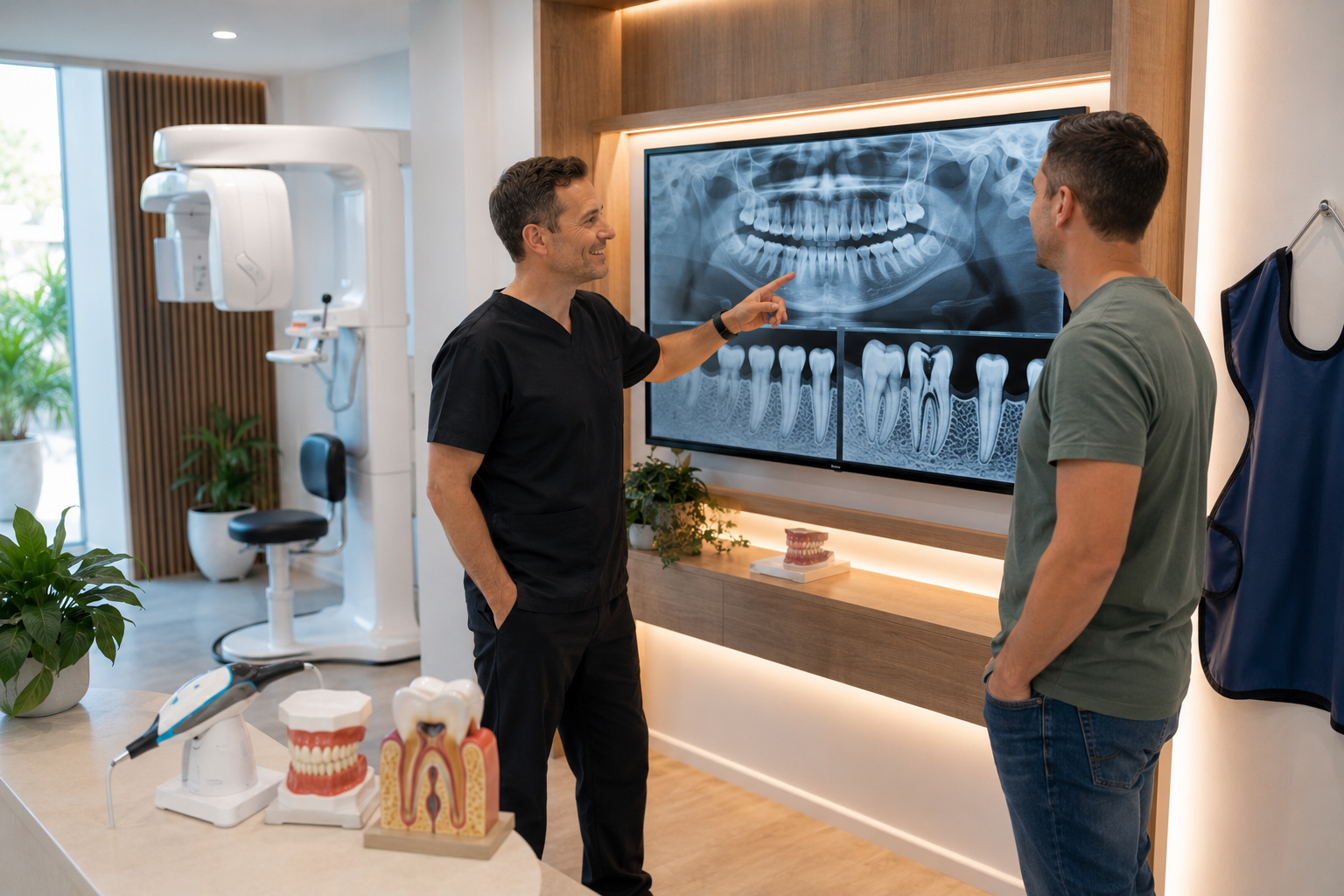
At Mary Street Dental Gympie, dental X-rays are always reviewed with you on screen, not hidden away.
The dentist points out each area of interest in plain language, avoiding heavy technical terms.
Patients often find that seeing the problem themselves makes choices like root canal treatment or extraction much clearer.
Digital images can be zoomed and adjusted so you can see small cavities, cracks or infection areas more easily.
In some cases, intraoral scanners and 3D imaging support the X-rays, especially for cosmetic and implant planning.
This visual approach helps anxious patients feel more in control, because decisions are made together with clear evidence in front of everyone.
The practice invests time in answering questions before any work begins.
If you prefer to move slowly or need extra reassurance, the team can also explain how nitrous oxide, oral sedation or IV sedation may fit into your broader treatment plan.
That way, your dental imaging in Gympie becomes part of a calm, predictable experience rather than a source of stress.
How Dental X-Rays Support Different Patients At Mary Street Dental Gympie
Dental X-rays support different Gympie patients in different ways, from toddlers to veterans.
Each image is chosen to match the person’s age, health, risk level and treatment goals.
This personalised approach helps Mary Street Dental care for families from Gympie, Tin Can Bay, the Mary Valley and surrounding communities.
For some patients, the focus is early decay detection and simple fillings.
For others, images guide full mouth rehabilitation, implant placement or emergency care after an accident.
Across all these needs, low dose digital X-rays help the team plan treatment that is accurate, efficient and as gentle as possible.
The practice links imaging with broader services like CEREC same day crowns, cosmetic dentistry, children’s check ups and emergency appointments.
This means many patients can have a Gympie dentist X-ray, diagnosis and treatment arranged in a single convenient location.
Children, Anxious Adults And Families
For children, dental X-rays are mainly about growth, tooth position and early decay.
Bitewing X-rays help find small cavities between molars so they can be treated with minimal fillings rather than extractions later.
Panoramic views show whether adult teeth are present, if any are blocked, and how much space is available.
Mary Street Dental Gympie uses child sized digital sensors and calm explanations to keep dental X-rays for children as comfortable as possible.
Parents can discuss timing and necessity, and eligibility for the Child Dental Benefits Schedule (CDBS) means many children’s X-rays are bulk billed under Medicare.
According to AIHW reports from recent years, many Australian children still experience preventable tooth decay, so these early checks matter.
Anxious adults often benefit from imaging that reduces guesswork.
Clear digital X-rays mean the dentist can see the problem before starting, which shortens treatment and reduces surprises.
For those who need sedation dentistry, X-rays taken ahead of time help plan work so that as much as possible can be done in one relaxed visit.
Families from Gympie, Widgee, Kilkivan, Glastonbury and nearby towns appreciate having general dentistry, dental scans and emergency care in one trusted practice.
Shared records across the family make it easier to track patterns like enamel weakness or gum issues over time.
Cosmetic, Restorative, Seniors And Emergency Patients
For cosmetic and restorative patients, X-rays are key to checking the health of teeth before investing in veneers, crowns or bridges.
Dentists use bitewing and periapical X-rays to assess the tooth foundations under old fillings and to look for hidden infection.
Panoramic and CBCT images support implant planning by showing bone height, width and the position of nerves and sinuses.
Seniors and veterans often have a mix of natural teeth, dentures, crowns and implants.
Dental X-rays help monitor root decay, bone changes around implants and any issues beneath existing dentures.
Mary Street Dental Gympie works with the Department of Veterans’ Affairs so eligible DVA card holders can receive necessary imaging and treatment with minimal out of pocket cost.
Emergency patients rely heavily on fast imaging.
A periapical X-ray for severe toothache can reveal deep decay, a cracked root or a failed old root canal, which guides immediate relief.
After trauma, dental X-rays show whether teeth or bone are fractured and whether any fragments remain in the tissues.
Because Mary Street Dental Gympie uses instant digital X-rays, diagnosis and first stage treatment can usually begin in the same appointment.
This quick response matters when someone has been injured on the sports field or wakes in the night with intense dental pain.
Final Thoughts On Dental X-Rays
Dental X-rays give your dentist a clear view of what is happening below the surface, from tiny cavities to deeper infections and bone loss.
Used thoughtfully, they help detect problems early, guide safe treatment and support long term oral health for Gympie patients of all ages.
Different dental X-ray types are chosen carefully so you get the most useful information with the least exposure.
Modern systems at Mary Street Dental Gympie use low dose digital radiography and, when needed, advanced 3D imaging.
Combined with a gentle, no judgement approach and strong support for dental anxiety, this technology makes dental imaging a calm, informative part of your visit.
Health fund rebates, CDBS and DVA support help keep necessary X-rays and follow up care accessible.
If it has been a while since your last check up, or you have a niggling tooth that worries you, a thorough exam with the right dental X-rays can give clear answers.
Contact Mary Street Dental in Gympie today to book a comprehensive dental examination so any hidden problems are found early and your smile stays healthy for years ahead.
See What Your Dental X-Rays Reveal
Many dental problems develop quietly before they cause pain or become visible. A comprehensive dental examination, supported by low-dose digital X-rays when clinically needed, allows hidden issues to be identified early so treatment can often be simpler, more comfortable and more affordable.
If you’re due for a check-up, have ongoing tooth pain, or simply want peace of mind about your oral health, book an appointment with Mary Street Dental. Our friendly Gympie team will explain your X-rays in clear, everyday language, answer all your questions and create a personalised treatment plan designed to keep your smile healthy for years to come.
Frequently Asked Questions
Question Do Dental X-Rays Really Show Tooth Decay And Cavities?
Yes, dental X-rays really do show tooth decay and cavities.
Question: Do Dental X-Rays Really Show Tooth Decay And Cavities?
On a bitewing X-ray, decay appears as darker patches in the enamel or dentine, especially between teeth.
Dentists also use these images to find decay hiding under old fillings or crowns that cannot be seen in the mirror, so treatment can start before pain appears.
Question Are Dental X-Rays Safe For Children And Teenagers?
Yes, modern digital dental X-rays are considered very safe for children and teenagers.
Question: Are Dental X-Rays Safe For Children And Teenagers?
Dentists use child sized settings, a limited number of images and protective lead aprons to keep exposure low.
These X-rays help detect early decay and track tooth and jaw development, which is especially important while children’s mouths grow and change.
Question What Happens During A Dental X-Ray Appointment At Mary Street Dental Gympie?
During a typical visit, dental X-rays at Mary Street Dental Gympie are quick and simple.
Question: What Happens During A Dental X-Ray Appointment At Mary Street Dental Gympie?
You answer a few health and pregnancy questions, then a small sensor is placed in your mouth or you stand in a panoramic machine.
The exposure only lasts a moment, the image appears on screen within seconds, and the dentist explains what it shows straight away.
Question How Much Do Dental X-Rays Cost In Australia, And Are They Covered By Insurance?
Dental X-ray cost in Australia varies with the type of image and whether it is taken in a clinic or radiology centre.
Question: How Much Do Dental X-Rays Cost In Australia, And Are They Covered By Insurance?
Small intraoral X-rays usually cost less than panoramic or CBCT scans.
Many extras health funds offer rebates on eligible dental X-rays, and at Mary Street Dental Gympie, HICAPS, CDBS and DVA arrangements help make necessary imaging more affordable.
Question Can I Refuse A Dental X-Ray If I Am Worried About Radiation?
Yes, you can refuse a dental X-ray, though it may limit what treatment can be done safely.
Question: Can I Refuse A Dental X-Ray If I’m Worried About Radiation?
Your dentist should explain why the image is recommended and what risks come with skipping it, such as missed decay or hidden infection.
A calm discussion usually leads to a plan that respects your wishes while keeping care safe.
Question Do Dental X-Rays Hurt Or Make You Gag?
Dental X-rays themselves are painless, though the sensor can feel a little bulky for a few seconds.
Question: Do Dental X-Rays Hurt Or Make You Gag?
For people with a strong gag reflex, the team can use smaller sensors, gentle placement and breathing tips, or choose external views like panoramic X-rays where suitable.
Staff at Mary Street Dental Gympie take an unhurried, gentle approach so even sensitive patients cope well.